Long before drone shows became part of festivals or brand launches, researchers were already tackling a much harder problem: how to make multiple flying machines move precisely in a shared airspace without hitting each other.
Part of this work, including research at ETH Zurich, builds on multi-robot systems from the late 1990s. By 2000, the team led by Raffaello D’Andrea had already built a quadcopter prototype with LEDs and camera-based positioning.
That doesn’t mean drone light shows existed yet. Not really.
But the key elements were already there — tracking, control, choreography, and illuminated airborne objects.
Around the same time, researchers at University of Pennsylvania were making autonomous quadrotor swarms visible to a broader audience. By 2012, their flying robots were going viral for formation flights and even simple musical routines.
The researchers weren’t aiming to create entertainment. Their main goal was real-world use — especially applications like search and rescue.
Still, those demos made it clear: coordinated aerial robotics could be both functional and visually powerful.
Why 2012 was the turning point
If there’s a year where drone shows start to look like actual drone shows — it’s 2012.
Two different directions emerged almost simultaneously.
One came from the art world. At Cannes, the project Meet Your Creator combined quadrotor drones, LEDs, mirrors, moving lights, and choreography into a live performance. It was called a robo-ballet — programmable light sculptures in motion.
The second came from outdoor aerial formations. In 2012, Ars Electronica Futurelab presented the Spaxels premiere in Linz and called it “the world’s first outdoor LED drone formation flight.”
That claim matters.
Because it connects all the key elements in one place: drone swarms, outdoor night performance, LED visibility, and coordinated aerial imagery. In other words — the exact DNA of modern drone light shows.
Who turned the idea into a real medium
After those early milestones, the story shifts. What matters now is structure, scale, and repeatability.
In 2013, The Walt Disney Company filed a patent for Aerial display system with floating pixels (or flixels). Published in 2014, it described a system of multiple UAVs, individual flight paths, and synchronized display control.
It didn’t mean Disney invented drone shows. It shows how early major entertainment players definitelty recognized the potential.
As of 2015 things scaled fast.
Intel collaborated with Ars Electronica on Drone 100, setting a Guinness World Record for 100 drones flying simultaneously. To compare: the largest drone show in 2026 (at the time of writing this article) had 22,580 UAVs.
From that point on, drone shows started to look less like experiments and more like a product.
The mainstream breakthrough followed quickly:
- 2016 — 300 drones at Disney Springs in the U.S.
- 2017 — first drone integration in a televised Super Bowl performance (Super Bowl LI)
- 2018 — 1,218 drones at the PyeongChang 2018 Winter Olympics opening ceremony
At the same time, indoor drone shows were evolving in parallel.
In 2016, Verity Studios presented what it called the world’s first autonomous indoor drone light show at TED performed with 33 micro drones.
Why regulation and safety became part of the product
Serious drone shows are not only designed as visual performances.
They are also designed as aviation operations.
In the U.S., the FAA requires special permits for night flights, VLOS (flying beyond visual line of sight), and controlling multiple drones, as well as Remote ID. In Europe, EASA requires registration and approval for higher-risk operations. In the Gulf region, authorities also require permits and strict safety rules for drone flights.
That’s what makes drone shows reliable at scale.
And there’s another point worth noting. When it comes to spectacle, drone shows are often compared to fireworks — yet they’re far more controlled and eco-friendly. No loud explosions, no air pollution, no debris falling over the area.
Drone light displays are not just about visuals — but airspace, approvals, and operational control.
Who is driving the industry today
Creative breakthroughs alone don’t define an industry — scalable technology and operational systems do.
Platforms like Intel’s Shooting Star drones — lightweight (≈280 g), equipped with advanced LED systems and controlled in large fleets from a single computer — marked a major step toward mass use.
But the real shift came from the ecosystem around the hardware:
simulation tools, animation pipelines, site planning, aviation approvals, and standardized show formats.
Today, drone shows rely on high-precision positioning and centralized control. Large companies use RTK-GNSS technology to achieve centimeter-level accuracy across large swarms.
The scale reached today highlights the industry’s maturity:
- 10,197 drones — Shenzhen, 2024
- 22,580 drones — EHang “Egret” performance, 2026.
As any hi-tech, drone technology evolves rapidly. Next to longer and larger shows, the top providers offer extra visual solutions using light drones. In Lumaksy, we uplevel light displays with pyro drones, flash drones, pyro planes, and laser drones. And more is yet to come.
Another top-notch format is interactivity.
Lumasky has developed the technology that allows audiences to influence the performance live. Gaming or drawing in the sky, motion tracking, crowd ovations turning into live drone-built equalizer.
So instead of just watching a pre-programmed sequence, spectators become part of the show in real time. More about how interactive drone shows work — here.
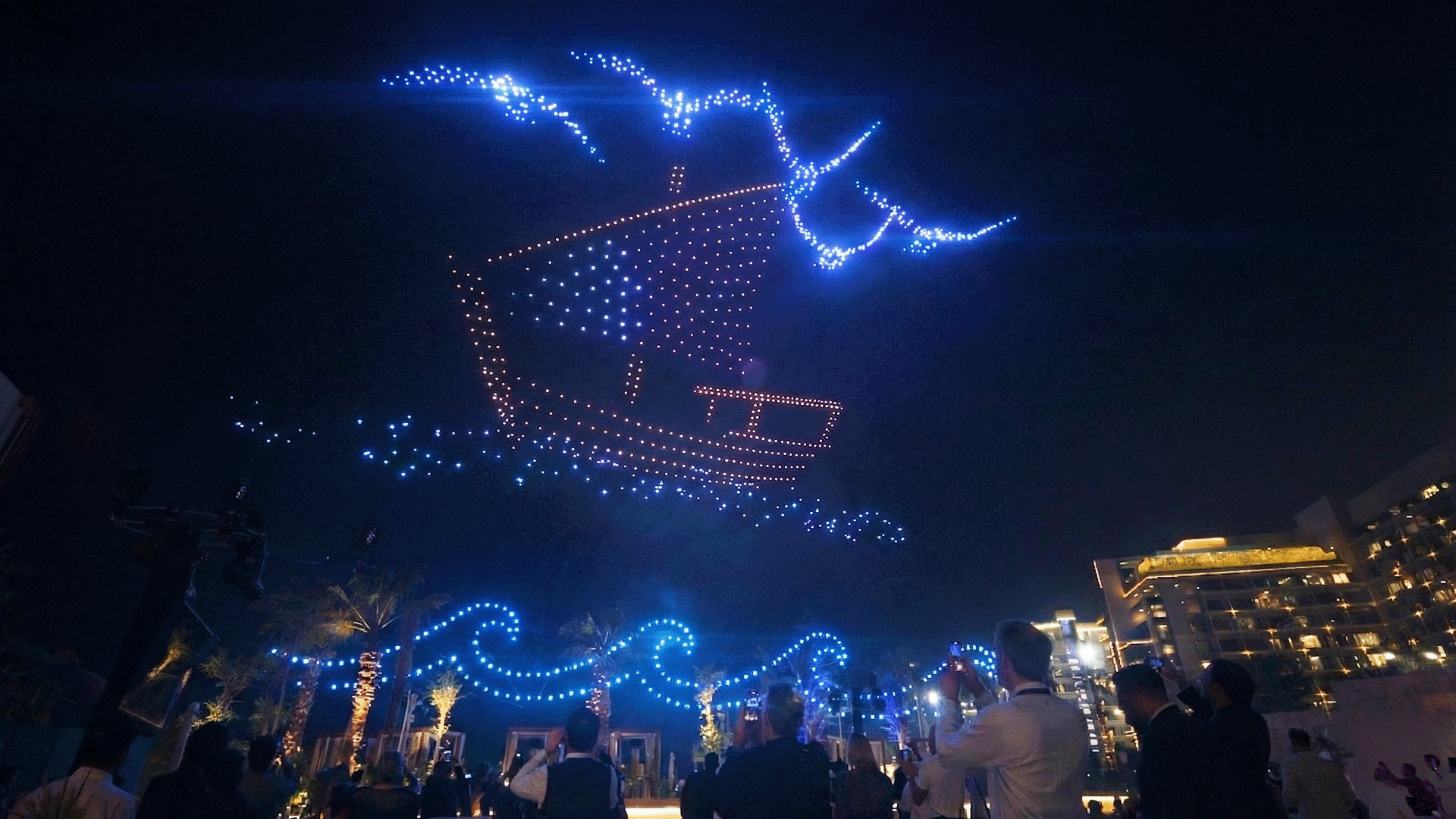
So who really introduced drone light shows to the world?
There is no single founder, be it a person or a comapny. Drone shows were shaped by multiple groups over time: researchers built the tech, artists turned it into visuals, entertainment companies structured the format, Intel scaled outdoor shows, Verity Studios advanced indoor autonomy, and regulators made it a professional category.
In today’s fast-evolving space, we’ll keep seeing new features, new records, and new players entering the drone show industry.
Let’s stay tuned.